
Argon2id vs bcrypt vs scrypt vs PBKDF2: Which Is Best in 2026?
Picking a password hashing algorithm is one of those decisions that feels technical but has very real consequences. Get it right, and a stolen database is little more than an inconvenience for attackers. Get it wrong, and you hand them a head start they'll exploit with cloud GPUs and rented cracking clusters.
Four algorithms dominate serious discussions in 2026: Argon2id, bcrypt, scrypt, and PBKDF2. This guide compares them head-to-head so you can make a decision you won't regret in three years.
New to the concept? Start with password hashing explained — what hashing is, why salts matter, and why SHA-256 is the wrong tool. Ready to implement? Our best practices and migration guide has the exact parameters and code.
How to Choose: Start With Your Threat Model
There is no universal "best" algorithm in isolation. The right choice depends on the sensitivity of the data you protect, your authentication volume, available CPU and RAM, compliance requirements, and long-term maintainability. Keep those factors in mind as you read.
Argon2id: The Default Recommendation
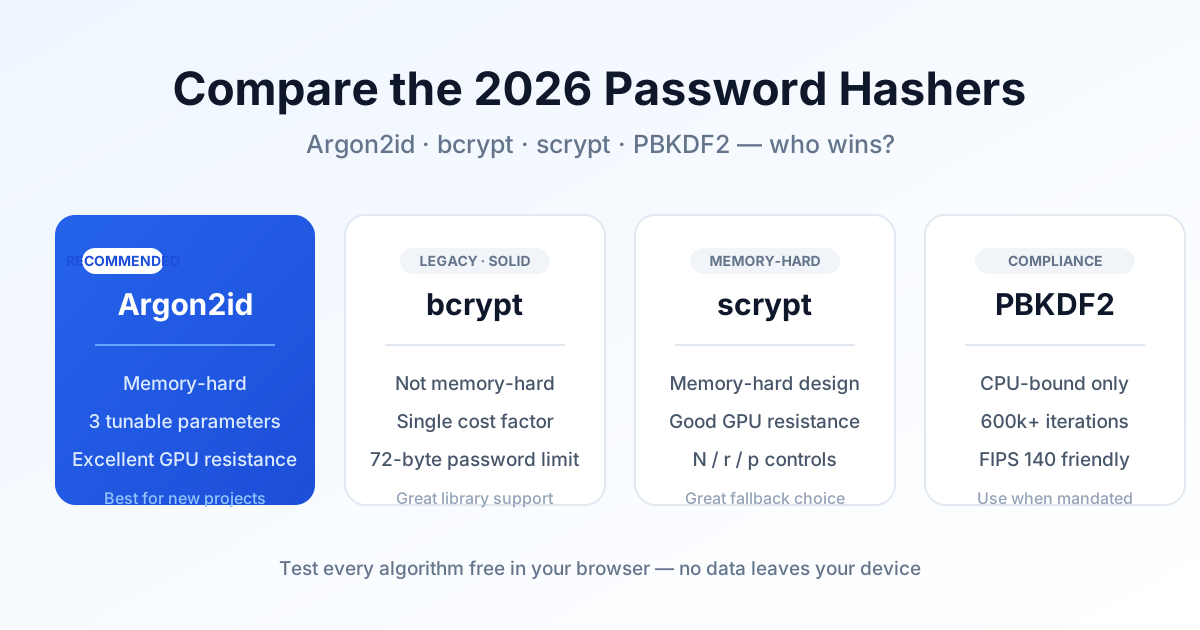
Argon2 won the Password Hashing Competition, and its id variant has become the go-to recommendation from OWASP and most security teams building new systems in 2026. It is the only widely recommended algorithm that combines three independent, tunable parameters: memory cost, time cost (iterations), and parallelism.
What makes Argon2id special is memory hardness. Every password guess must consume a configurable amount of RAM. GPU cracking rigs excel at raw computation but are comparatively limited on memory per core, so Argon2id breaks the economics of large-scale parallel cracking in a way CPU-only schemes cannot.
A reasonable starting point for a typical web application:
- Memory: 19–64 MiB (higher if your infrastructure can afford it)
- Time cost: 2–3 iterations
- Parallelism: 1–4, matched to your available cores
Target roughly 250–500 ms per verification on your production hardware — then benchmark, don't guess. You can experiment with real values using our Argon2 Hash tool.
bcrypt: The Reliable Veteran
bcrypt has protected passwords since 1999 and has never been fundamentally broken — it's simply been outpaced. It's still a perfectly defensible choice, especially for legacy systems, because:
- It has mature, battle-tested implementations in virtually every language.
- A single cost factor is easy to reason about and tune.
- It has survived 25+ years of public scrutiny.
Its weaknesses relative to Argon2id are real but not fatal: bcrypt is not memory-hard, so GPUs accelerate it better than Argon2id, and it has a hard 72-byte password limit — longer passwords get silently truncated in many implementations, which can create unexpected collisions.
A work factor (cost) of 12–14 is the common 2026 baseline. Verify your hardware can absorb the latency — our Bcrypt Hash tool lets you test different costs interactively.
Argon2id vs bcrypt: Side by Side
| Feature | Argon2id | bcrypt |
|---|---|---|
| Memory-hard | Yes | No |
| GPU resistance | Excellent | Good |
| Configurable memory | Yes | No |
| Configurable iterations | Yes | Limited (single cost) |
| Parallelism | Yes | No |
| Password length limit | Practically none | 72 bytes |
| Best use case | New applications | Existing systems |
scrypt: The Memory-Hard Middle Option
scrypt predates Argon2id and is also memory-hard. It saw heavy adoption in cryptocurrency contexts and remains cryptographically sound. Its main practical drawback in 2026 is ecosystem momentum — Argon2id is simply the more common default in modern frameworks, so scrypt shows up less often in fresh tutorials and starter templates.
If your stack already has strong scrypt support, there is no urgent reason to switch. Configure it with solid N/r/p values and treat it as a secure fallback when Argon2id libraries are unavailable. You can test parameters with our scrypt Hash tool.
PBKDF2: The Compliance-Driven Choice
PBKDF2 remains relevant in 2026 almost entirely because of compliance. It is part of FIPS 140 validated modules, which matters for U.S. federal systems and certain regulated industries. On pure security merits, it is the weakest of the four because it lacks memory hardness entirely — GPU attackers can parallelize PBKDF2 cracking far more efficiently than Argon2id or scrypt at comparable time costs.
If a compliance mandate names PBKDF2, compensate with a high iteration count (six figures is the 2026 baseline) and a strong unique salt per user. Otherwise, there is little reason to prefer it over Argon2id. Generate and test settings in our PBKDF2 Derivation tool.
All Four Algorithms at a Glance
| Algorithm | Memory-hard? | Best for | 2026 verdict |
|---|---|---|---|
| Argon2id | Yes | New projects, general use | Default recommendation |
| bcrypt | No | Legacy systems, broad compatibility | Still solid — migrate opportunistically |
| scrypt | Yes | Existing scrypt stacks, fallback | Sound, less common default |
| PBKDF2 | No | FIPS / compliance mandates | Only when required, with high iterations |
Which Password Hashing Algorithm Should You Choose?
Choose Argon2id if…
You're building something new, security is a priority, and your framework supports it. It is the best long-term investment in 2026.
Choose bcrypt if…
Your application already uses it and migration would be expensive. Raise the cost factor and plan a gradual migration rather than an emergency one.
Choose scrypt if…
Your infrastructure already relies on it, or you need a memory-hard algorithm and cannot adopt Argon2id.
Choose PBKDF2 if…
Your organization requires FIPS-compatible algorithms or enterprise compliance standards dictate it.
Frequently Asked Questions
Which password hashing algorithm is best in 2026?
For most new applications, Argon2id. It combines configurable memory, CPU time, and parallelism into a memory-hard function that resists GPU attacks. Use bcrypt on legacy systems, scrypt as a fallback, and PBKDF2 only when compliance requires it.
Is bcrypt still secure in 2026?
Yes, when configured with an adequate cost factor (12–14) and unique salts. It is not memory-hard and truncates passwords at 72 bytes, which is why Argon2id is preferred for new systems — but there is no emergency reason to migrate.
What is the difference between Argon2 and bcrypt?
Argon2 is memory-hard and exposes three tunable parameters, while bcrypt mainly increases CPU cost with a single cost factor and truncates at 72 bytes. Memory hardness is what makes Argon2 significantly harder to accelerate on GPUs.
When should I use PBKDF2 instead of Argon2id?
Only when FIPS 140 validated environments or a compliance mandate require it. PBKDF2 is CPU-bound and easier to accelerate on GPUs, so Argon2id is strictly stronger on pure security grounds.
Why is scrypt less popular than Argon2id?
scrypt is still a sound memory-hard algorithm — Argon2id simply became the widely recommended default after winning the Password Hashing Competition, so most frameworks now favor it.
The Bottom Line
If you're asking which is the best password hashing algorithm for a new project, Argon2id is the answer in 2026 — with bcrypt as the safe legacy default. Tune it to your actual server hardware and login traffic. If you're maintaining a bcrypt system, there's no fire alarm — keep it and migrate opportunistically. Reach for scrypt when your ecosystem supports it well, and use PBKDF2 only under compliance pressure.
Whichever you pick, pair it with unique per-user salts and parameters validated against real load testing. That combination — more than the algorithm name — is what keeps a password database safe when it inevitably ends up somewhere it shouldn't.
Ready to move from theory to practice? Read the password hashing best practices and migration guide for exact parameters and code. And if any of the basics were fuzzy, go back to password hashing explained.
Once you've settled on an algorithm, generate strong test credentials with the Password Generator and check that user passwords hold up with the Strength Checker. Shaping the user-side policy too? Our guide to password strength in 2026 covers what you should actually require.